Where Does Haiti Go from Here: Pandemonium or Progress?
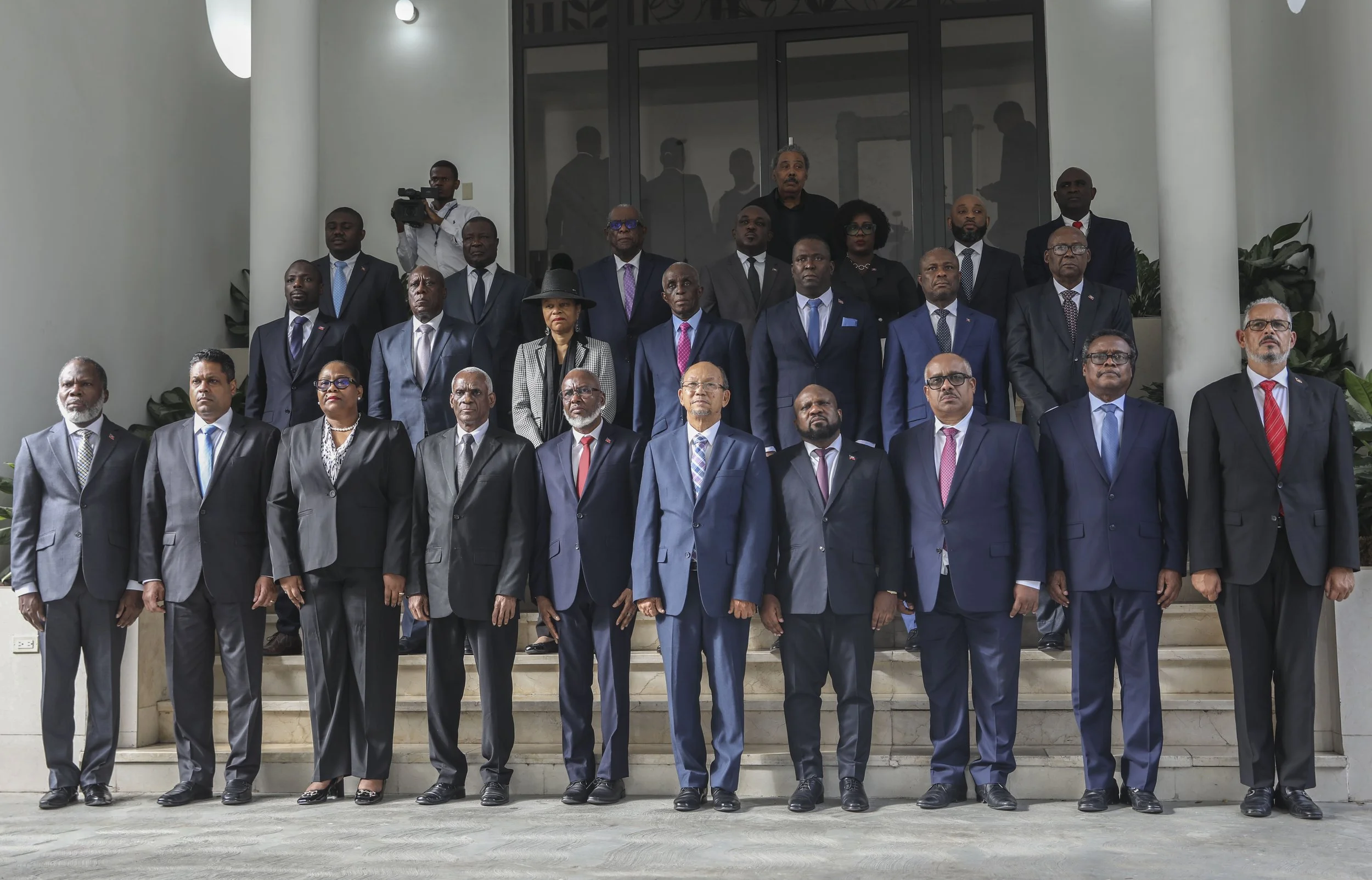
Haiti's new Prime Minister Alix Didier Fils-Aimé, front right, poses for photos with members of the transitional council and his cabinet members, in Port-au-Prince, Haiti, Saturday, Nov. 16, 2024. (AP Photo/Odelyn Joseph)
Balancing Crisis Management and Long-Term Stability
December 16th will mark the 35th anniversary of Haiti’s first democratic elections, electing Jean-Bertrand Aristide as the country’s first democratically elected president. Following nearly three decades of dictatorship that claimed countless lives and established an economy of corruption and kleptocracy, the December 1990 elections represented a glimmer of hope. However, a military coup led by Gen. Raoul Cédras delivered the first blow to Haiti’s nascent democracy when he overthrew and forced President Aristide into exile nine months later, in September 1991. This event not only toppled a leader; it also halted a democratic process and squandered the opportunity for a strong democratic foundation that would continue to undermine Haiti’s future.
Since 2021, Haiti has been confronted by a confluence of political, security, and humanitarian crises, one of the most severe crises in its history. The creation of the Transitional Presidential Council (TPC) in April 2024, whose term also ends in February 2026, and the presence of the Kenya-led Multinational Security Support (MSS) troops in Haiti since June 2024 failed to stem the widespread insecurity and restore democracy. Consequently, in August 2025, the Organization of the American States (OAS) announced a $2.6 billion roadmap to help Haiti. A month later, the UN Security Council approved a US-led Resolution to transform the currently operating MSS into a Gang Suppression Force (GSF), with an expanded mandate to take on Haiti’s armed groups.
As the crisis enters its fifth year, and as discussions intensify around a new transitional government and a stronger security mission, policymakers must confront the root cause of Haiti’s turmoil: the failed democratic transition following 1986. Addressing urgent needs, restoring security, providing humanitarian aid, and organizing credible elections are critical. However, that alone will not lift Haiti out of the abyss. Stakeholders must also implement long-term policy measures to rebuild Haiti’s institutional foundation. To achieve this, Haiti’s leaders, supported by the international community, should split responsibilities: the prime minister handles short-term challenges, while the CPT focuses on structural reforms to sustain stability over the years.
1986-1994: Failed democratization process
On February 7th, 1986, Haiti’s dictator, Jean-Claude Duvalier, fled to France amid growing food riots and pro-democracy protests. Army Lt-Gen. Henri Namphy took over Haiti’s presidency as part of a five-member National Council of Government. After successive provisional governments and contested elections (See Table below), Jean-Bertrand Aristide, a Salesian priest thrust by a desperate mass that adhered to his liberation theology, became Haiti’s first democratic president in February 1991. Eight months later, on September 30th, the military, including Duvalier loyalists, overthrew Aristide on the pretense of protecting Haiti’s institutions following Aristide’s purge of the military.
Haiti Interim Governments, 1986–1991
| Month-Year | President | Succeeded | Election/Coup | Party |
|---|---|---|---|---|
| Feb. 1986 | Lt. Gen. Henry Namphy | Jean-Claude Duvalier | Departure of President Jean-Claude Duvalier (flight into exile) | Chairman of the National Council of Government |
| Feb. 1988 | Leslie François Manigat | Lt. Gen. Henry Namphy | Constitutional election | Rassemblement des démocrates nationaux progressistes, RDNP |
| June 1988 | Lt. Gen. Henry Namphy | Leslie François Manigat | Military coup d’état | Military |
| Sept. 1988 | Gen. Matthieu Prosper Avril | Lt. Gen. Henry Namphy | Military coup d’état | Military |
| Mar 1990 | Hérard Abraham | Gen. Matthieu Prosper Avril | Departure of President Prosper Avril (flight into exile) | Military *(voluntarily gave up power 3 days later) |
| Mar 1990 | Ertha-Pascal Trouillot | Hérard Abraham | Resignation of General Hérard Abraham | Chief Justice of the Court de Cassation |
While in exile in the United States, Aristide pressured the international community, particularly the Americans, to reinstate him. In Haiti, the military clamped down on protests, operated extrajudicial killings, and continued the legacy of corruption bequeathed by the old regime. Faced with extensive pressure and an OAS- and US-embargo, called for by Aristide, that pushed Haiti’s struggling economy to the brink, Cédras agreed to resign just hours before a U.S. military contingent landed to remove him by force. The Clinton Administration’s Operation Uphold Democracy restored President Aristide in October 1994.
Building on the rubble
1994 & 2004: Upon his return, President Aristide implemented a series of economic reforms under the guidance of the Bretton Woods institutions. Designed to reverse Haiti’s economic decline, these policies not only failed but also shifted wealth from the government to private entities without ensuring they would reinvest in the economy. In 2000, Aristide was re-elected for a second term, succeeding Rene Preval, who had served as President Aristide’s prime minister and took office in 1996. Aristide was forced into exile again in February 2004 amid a violent rebellion and accusations of colluding with armed gangs. In response to increasing insecurity, international stakeholders responded with another U.N. peacekeeping mission: MINUSTAH.
2010: Haiti experienced a devastating 7.0 magnitude earthquake in January 2010 that claimed over 200,000 lives and caused an estimated US$7.8 billion in economic damage (120% of its GDP). The removal of Aristide in 2004 and the 2010 earthquake not only placed significant social and economic pressures on Haiti’s already strained system but also influenced how the international community engaged with Haiti moving forward.
2011-2020: In 2011, popular musician Joseph Michel “Sweet Micky” Martelly became Haiti’s president after a contested election cycle. While enjoying broad support initially, Martelly’s presidency only added to Haiti’s struggles by legitimizing the gangsterization of Haiti, “Bandi legal,” and corruption. Jovenel Moise, Martelly’s protégé, became Haiti’s president in 2017. In that same year, MINUSTAH left Haiti amid major discontent and was replaced by MINUJUSTH and later BINUH to support Haitian leaders in bolstering security, justice, and institutions. Paradoxically, this period coincides with Haiti’s steepest decline in institutions and security, culminating in the assassination of its president.
2021-2025: the total collapse
On July 7th, 2021, Haiti awoke to the news that President Jovenel Moise had been assassinated. At that time, Mr. Moise was Haiti’s only elected leader after failing to organize midterm elections. This plunged Haiti into a crisis with no constitutional solution. After a short spat between the designated prime minister, Ariel Henry, and then prime minister Claude Joseph, the former was able to retain Haiti’s leadership until his resignation in April 2024 to make way for the CPT. Since 2021, Haiti has been without a single elected representative, and armed gangs have built coalitions to control government infrastructure, block key roads, and besiege the capital. Haiti’s collapse is reflected even more poignantly in political instability, with ten provisional governments since 1986, institutional breakdown, no elections held since 2015 and a governance crisis with no constitutional provision, economic decline, real GDP shrinking by an average of 3.2% annually after 2020, widespread violence for political and financial ends, and unchecked foreign interference and ineffective foreign interventions, ten since 1994.
Haiti Warrants a Holistic Approach
If the current crisis appears to be a Gordian knot, it’s because, for years, Haitian leaders and the international community have failed to address the Haitian issue holistically. While Haiti got Aristide back in 1994, it never recovered its most significant loss: the chance for an orderly and steady democratic transition. This event and the subsequent missteps revealed the unpreparedness of Haiti’s elites to steer the country’s course. It also highlighted the international community’s lack of resolve and ability to capitalize on critical moments, shifting from self-isolation to supporting only a “Haitian-led solution,” only to ultimately implement plans that involve limited Haitian input.
The truth is that the country no longer has the luxury of choosing which crisis to tackle first. The issues are interconnected and mutually impact each other. The other reality is that neither Haiti alone nor the international community can resolve its problems. Therefore, Haitian and international stakeholders must combine short and long-term measures to address the most pressing issues, such as security and humanitarian relief, while taking steps to ensure that Haiti becomes a self-sustaining democracy.
The prime minister paves the road to 2027
When the TPC replaced Prime Minister Ariel Henry in April 2024, they had a clear mandate: to restore security, complete the constitutional reform process, and organize elections. They have failed. Gangs now control around 85% of the capital. The constitutional reform process has been paused, and holding elections before February 2026 is highly unlikely. As the Executor-in-Chief, the prime minister should be delegated authority and supported to coordinate short-term goals: security and humanitarian support to pave the way for elections by the end of 2026. The Haitian National Police (HNP) has shown that, when supported and supplied with resources, it can destabilize gangs. By pairing the HNP with the remobilized Haitian army, supported by the international security mission, they can restore security by year’s end. Mobilizing agencies like the Ministry of Social Services and Labor (MAST) and the Fund for Economic and Social Assistance (FAES), the government can bring relief to Haiti’s most vulnerable populations. Building on the Provisional Electoral Council’s (CEP) ongoing work, the government should work with the political parties and accompany the population to ensure an inclusive and fair process.
Taking over the short-term needs is in no way less important, nor should it mean the prime minister and his cabinet being left alone. They need the support of the TPC, the vital cooperation of the population, and, more importantly, the support of the international community to assuage the humanitarian emergency and suppress the gangs’ terror before Haiti can return to democratic governance. The TPC’s failure, among other reasons, is mainly due to its internal dysfunction, a rotating coordinator every quarter, and its inability to focus on tasks that have a real impact, even competing with the prime minister. However, everything isn’t lost yet. Establishing a clear division of labor, a set of responsibilities, and a delivery timeline is essential for accountability and to ensure we bring this transition to a successful conclusion, hence, salvage the process.
The TPC paves the road to 2050
The crisis Haiti faces today is not accidental. It is a coordinated effort to destabilize the country for the benefit of a few. It is this destructive trilogy (pages 12-13. See figure below): politicians, private sector entities, and armed individuals. Politicians and members of the economic elites use gangs to undermine political and economic rivals; in return, gangs obtain financial benefits and impunity. Economic and political elites also collude to control illicit activities, using their private ports and privileged positions to undermine the state’s capacity to control. This vicious cycle inhibits the state’s ability to serve its regalian purpose by continuously weakening the institutions, expanding the organized crime system, and recruiting or killing any reform movement. Against this backdrop, addressing the situation in Haiti must go beyond the ostensible crisis of today; it needs to tackle the root causes. To accomplish this, the TPC should take steps to strengthen Haiti’s political and economic institutions for the future. It must lay the groundwork for a stable and prosperous Haiti through a 30-year plan. This involves freeing institutions from harmful influences to enable them to perform their duties independently, finding a governance modus operandi to foster a culture of peaceful power transfers, and developing a plan to facilitate social and economic growth within a secure Haiti.
Figure 1.- Interconnections between elites and armed groups in Haiti
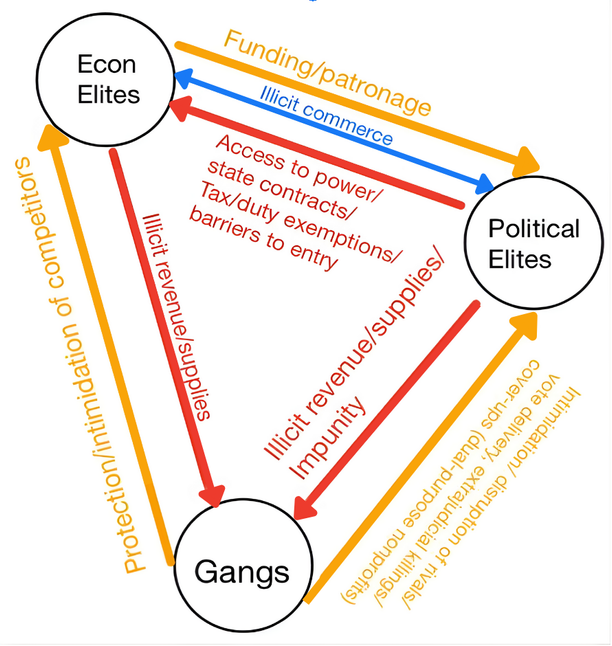
Source: UN Security Council, Final report of the Panel of Experts on Haiti. pp. 12-13. Figure created by the author
To begin, the TPC should complete the constitutional reform process. While the 1987 Constitution is not the only root cause of Haiti’s governance problems, it contributes to many tensions due to ambiguous articles, loopholes, and the failure to clearly delineate the different powers in practice. For instance, the feud over Article 134.1 and 134.2 of the Constitution related to the end of Mr. Moïse’s presidential term should be avoided in the future. Other issues include the subjection of key members of the judiciary to the executive branch. For instance, President Moise unconstitutionally blocked the nomination of several judges, some of whom were investigating people close to him. The legislative branch’s de facto superiority over the executive branch, the tension between the president (elected) and the prime minister (nominated and confirmed by parliament) due to the operational power given to the prime minister in comparison to the president, are all issues to address.
Another important step toward stabilizing Haiti is to agree on a governance framework that ends the curse of provisional governments. In Haiti, two presidents rarely succeed one another without a provisional government in between. Only former President René Préval completed two uninterrupted terms and turned power over to a democratically elected successor both times. To end this cycle, the TPC must engage all major parties and actors to agree on a governance pact that binds them to abandon violence, respect election results, and use only democratic means to gain power. In support of this stabilization process, the professionalization of its political parties would be a significant contributing factor. In 2014, President Martelly substantially relaxed the requirements for creating a political party, lowering the threshold from 5,000 members to only 20 signatories. This has led to the proliferation of poorly conceived and managed parties, with no ideological or national roots, except the power of political nuisance, in a precarious socio-political environment. The professionalization of political parties could bring tremendous benefits to Haiti’s political landscape, mainly the possibility of channeling political opposition within an institutional cadre rather than in the streets.
Finally, the TPC must also involve Haiti’s political, economic, and civil society groups to develop a socio-economic development and security plan for at least the next 30 years. In Haitian politics, the economy is often sidelined. When civil unrest occurs, a political agreement is typically the response, even if the original issue was the cost of living. A few politicians may benefit, while the real problems remain unaddressed. Over 50% of Haiti’s population is under 25, more than 90% of the economy is informal (page 6), and the country ranks 179 out of 189 in terms of a favorable environment for starting and running a business (2019). Therefore, a strategic economic plan, covering fiscal policy, trade policy, and infrastructure development, is essential for long-term stabilization. This plan, combined with a security strategy that protects the population, private property, and territorial integrity, would not only improve stability but also provide both small and large investors with the certainty needed to invest capital and ultimately boost economic growth.
Haiti is at a crossroads: transcendence and discernment can help, not business as usual.
In recent years, the phrase “Haiti fatigue” has become common among international policymakers who feel that Haiti always slips back into crisis, regardless of the support. Ironically, Haitians share this fatigue. For decades, policies shaping their lives have been driven by outsiders, yet their conditions have only worsened. Given that both sides are exhausted but cannot sever ties, a new approach is essential. This calls for Haitian leaders to move beyond political scheming and see themselves as part of a shared national effort. They must stop viewing Port-au-Prince as a workplace and instead see it as a home, where they and their families can live and prosper.
Likewise, this moment also calls on the international community to be more discerning, to learn from past missteps and abandon the piecemeal approach that has long defined its engagement with Haiti. For too long, it has treated Haiti’s crises as isolated issues. The time has come to change that by adopting a holistic strategy that addresses the interconnected political, security, and economic challenges, critical for the country’s long-term stability, and to prevent further regional security erosion. Given Haiti’s history with the OAS, UN, and the U.S., including their proximity, the Caribbean nation remains both a challenge and a test to multilateralism and global cooperation in an era of rising skepticism and fragmentation. Any attempt to recycle the past will fail, just as past attempts at international intervention have. However, a renewed and coordinated effort, such as this two-prong framework, can enable both Haitian and international actors to place Haiti on a sustainable path toward stability and prosperity.
Haiti Policy House is a not-for-profit institution focusing on Haitian public policy issues. Its research is nonpartisan. Haiti Policy House does not take specific policy positions. Accordingly, all views, positions, and conclusions expressed in this publication should be understood to be solely those of the author(s).
© 2025 by Haiti Policy House. All rights reserved.