September 2026 - Haiti Monthly Situation Brief
Flyover of Kenscoff and surrounding areas. Created by Haiti Policy House
Executive Assessment
Security deteriorated during the reporting period. While operations limited gang activity in parts of metropolitan Port-au-Prince, violence escalated in Kenscoff and other outlying areas. The August 23–24 massacre and mass abduction in Kenscoff exemplified this trend. The United Nations confirmed at least 47 fatalities, including five children, and over 50 abductions, with approximately 150 armed individuals involved. Community mediation supported by UNICEF secured the release of six children and seven women, though dozens remained captive according to the latest reliable reports.
Kenscoff illustrates the evolving armed threat. Gang networks are expanding beyond urban bases by establishing small rural cells, using mountain routes, conducting reconnaissance, and securing local footholds. Didi, also known as Izo 2, leads 5 Segond-linked groups in the Kenscoff hills. Reports indicate these groups use ravines and elevated terrain to bypass fixed security positions. Grand Ravine, Canaan, and Ti Bwa elements have also operated in the commune.
The armed neighborhood groups, also known as “Brigades”, have assumed a larger role in Kenscoff and Thomassin. The Brigade Communale de Kenscoff, or BRICK, has supported police and task-force operations, and Kenscoff brigadiers have fought Viv Ansanm directly. TPP, or Thomassin Pap Peri, operates farther north around Thomassin. Viv Ansanm has repeatedly attacked areas around Thomassin 32 and Thomassin 48, although a firefight involving TPP identified by name has not yet been independently documented. These groups provide manpower and local knowledge, but their growing role raises questions about command, weapons, detention authority, and accountability.
Election preparations continued despite worsening security. The Provisional Electoral Council reported about 1,200 registration and voting centers and opened a center for Cité Soleil. On September 2, the CEP extended candidate registration through October 14. The campaign calendar still begins on October 5, meaning campaigning would start nine days before the final candidate list is published unless the CEP changes the date.
Economic conditions stabilized at the headline level. Annual inflation slowed to 17.5 percent in July, though consumer prices still rose 0.9 percent that month. The official exchange rate was 130.5307 gourdes per U.S. dollar on September 6. The United States extended HOPE/HELP trade preferences through 2028, reducing immediate uncertainty for Haiti’s apparel sector. However, these improvements have not resulted in widespread household relief. IOM reported 4,238 people displaced by the August Kenscoff violence, with 80 percent staying with host families rather than in formal displacement sites.
Security and Gang Activity
Kenscoff Massacre and Mass Abduction
Gunmen entered central Kenscoff and surrounding localities during the night of August 23–24, attacking Centre-Ville, Vilier, Tête de l’Eau, Morne Jean Jacques, and nearby areas. According to the UN account, 13 people were killed while trying to flee. Another 34 were killed in and around a church where residents had taken shelter. More than 50 people were abducted, including children and members of entire families. The attacking force was estimated at approximately 150 people.
The scale of the attack quickly raised questions about the local security response. Police Director Vladimir Paraison ordered an inquiry into possible negligence or complicity. Residents later protested what they described as an inadequate response.
RNDDH Director Pierre Espérance said the local police commander had repeatedly warned of an impending attack and requested that additional personnel and an armored vehicle remain in Kenscoff. Espérance also said specialized staffing had fallen from 194 to 101 officers. Those claims have not yet been established by a published RNDDH report or findings from the police inspectorate.
Attribution and Local Embedding
Haiti Policy House identified 5 Segond elements, led locally by Didi (also known as Izo 2), as a principal armed network operating in Kenscoff. Other groups, including Grand Ravine, Canaan, and Ti Bwa, have also exerted sustained pressure on the commune. Gang activity has been documented in Bongars, Nouvelle-Touraine, Sourçailles, Grand Fond, and surrounding areas.
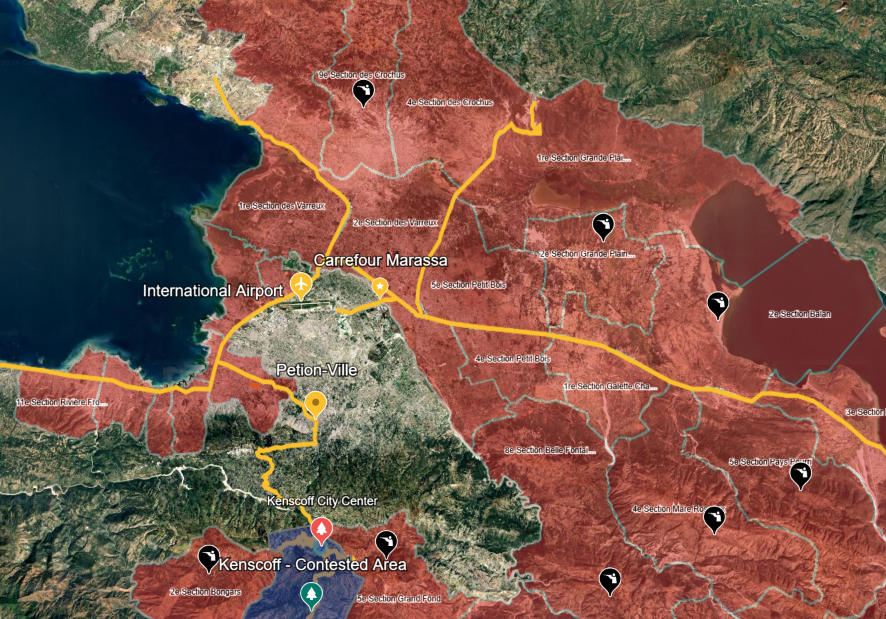
Figure 1- Map showing Port-Au-Prince. The yellow roads are major highways and roads connecting to other parts of the country. Created by Haiti Policy House
According to Haiti Policy House (HPH), Didi/Izo 2 not only directed the Kenscoff attack but also commands dispersed cells throughout the Kenscoff hills. These cells, often comprising around a dozen men, use ravines and elevated terrain to evade fixed security positions and can disperse or regroup as pressure fluctuates.
HPH assesses with high confidence that these locally embedded Izo 2/Didi cells, aligned with 5 Segond, have been central to the ongoing threat network and have Kenscoff. Other Viv Ansanm elements have also operated in the same area.
Earlier HPH analysis of 5 Segond’s Village-de-Dieu base highlighted the group’s access to drones, radio communications, fortified compounds, vehicles, and weapons. While this demonstrates the group’s capabilities at its urban base, it should not be assumed that all fighters or equipment involved in Kenscoff came directly from Village-de-Dieu.
Why Kenscoff Matters
Kenscoff sits above some of the capital’s most important southern and southeastern approaches. Armed groups operating from the hills can threaten Pétion-Ville, Fermathe, Fort Jacques, agricultural communities, and routes leading toward the Southeast.
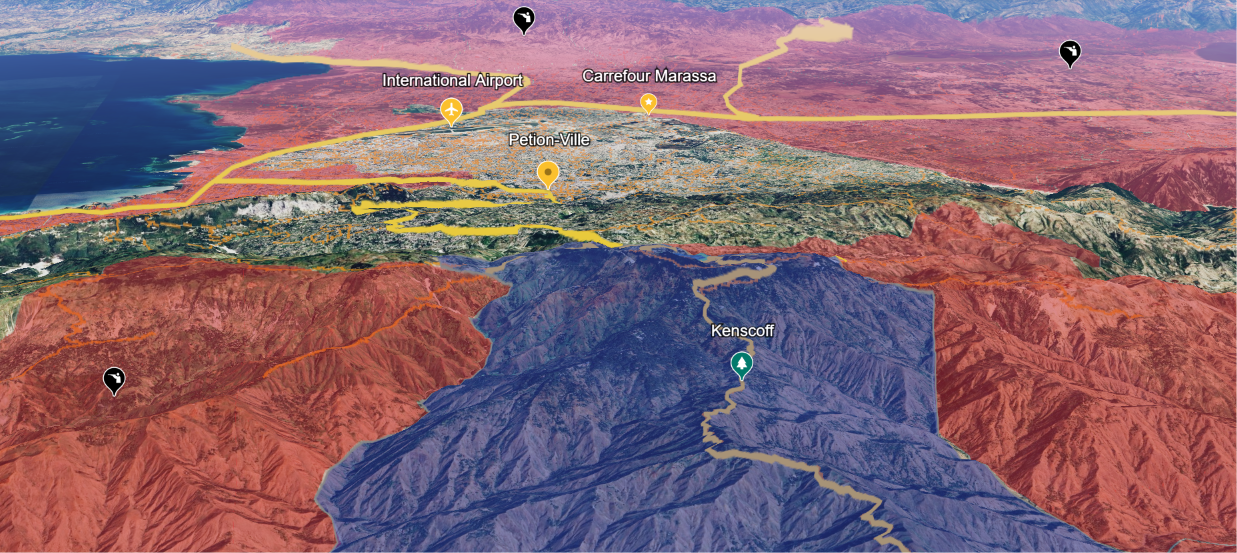
Figure 2 - Map showing Port-Au-Prince. The yellow roads are major highways and roads connecting to other parts of the country. Created by Haiti Policy House
The geography matters because other metropolitan corridors and major highways, like Route Nationale #1 from Port-au-Prince to Gonaives and further North through Taliban territory; Route Nationale #8 from Port-au-Prince to the Dominican Republic through 400 Mawozo Territory, are already heavily under gang control. Gang activity has repeatedly disrupted the northern and eastern approaches to Port-au-Prince, while Martissant, Carrefour, and Gressier have made the traditional southern route unreliable. Continued deterioration in Kenscoff would further reduce options for civilian movement, commercial traffic, humanitarian access, and security-force deployment.
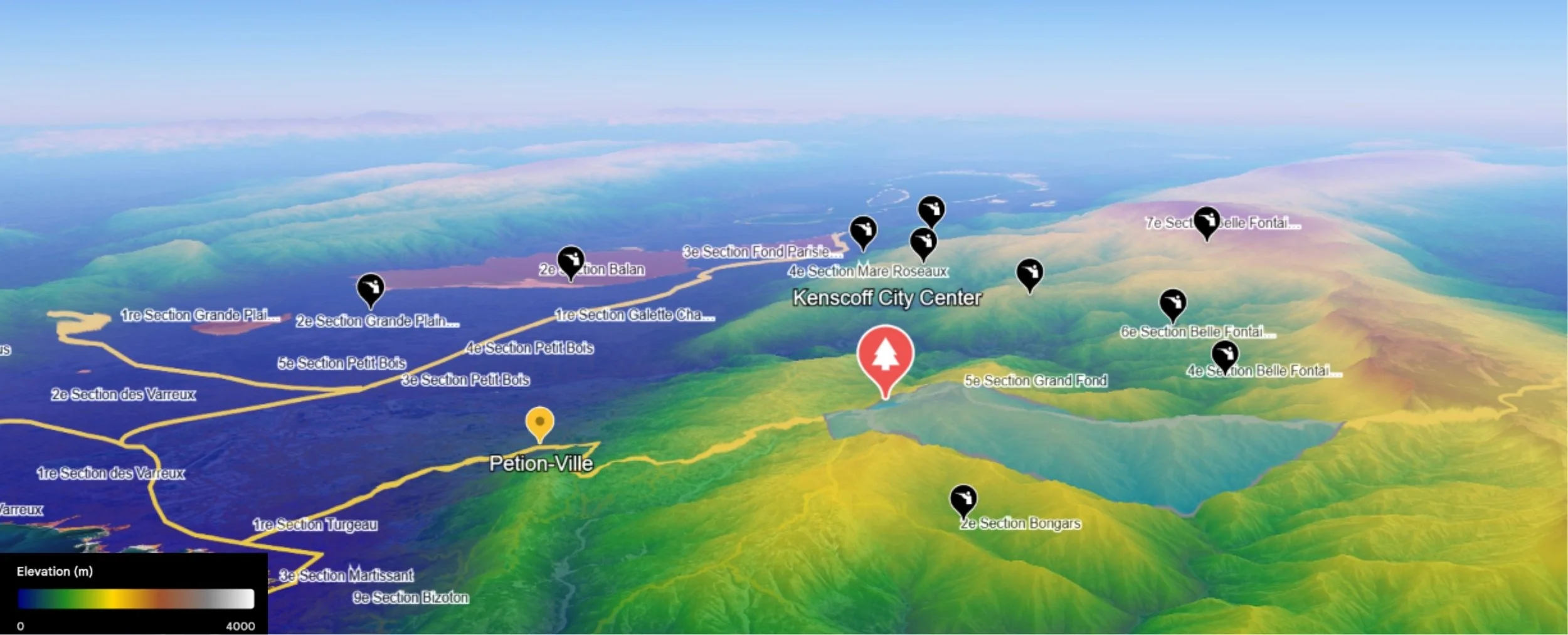
Figure 2.1- HPH elevation rendering of Kenscoff and surrounding communal sections. The image shows the broad contrast in relief but does not measure the grade, width, condition, or carrying capacity of individual roads.
The terrain limits the usefulness of equipment designed for broad urban roads. Heavy armored trucks can still provide protected transport and support on accessible approaches, but steep gradients, narrow bends, erosion, road damage, obstructions, and ambush points reduce their flexibility.
Operations in Kenscoff require units that can work away from vehicles, communicate across broken terrain, evacuate casualties, recover disabled equipment, and maintain access to secondary routes. Local knowledge and endurance become especially valuable. A temporary deployment has limited effect if armed cells return once the main force leaves.
For gangs, freedom of movement may be more useful than permanent occupation. Small units can leave an area under pressure, move through secondary routes, and reappear after security forces redeploy.
Local Defense Brigades
Armed community groups have become part of the security response in Kenscoff and surrounding towns. The best-documented organization is the Brigade Communale de Kenscoff, BRICK. HPH assesses that BRICK was integrated into police and task-force operations after the Viv Ansanm offensive that began in early 2025.
Kenscoff brigadiers have also participated in direct combat. On July 26, immediately before this reporting period, police and members of the local defense brigade fought Viv Ansanm attackers for several hours in Viard. Local reporting said at least six suspected gang members were killed. Viv Ansanm attacked Viard 2 again on August 7. Three police officers were injured, and an armored police vehicle was burned. FAd’H personnel and members of the commune’s vigilance brigade later reinforced the position.
Farther north, the vigilante group, TPP, Thomassin Pap Peri, operates in the Thomassin corridor and is associated in local reporting with Pierre “Ti Pierre” Milord. Police officials have described neighborhood brigades in the area as sometimes acting independently and at other times supporting state forces.
Viv Ansanm has repeatedly attacked the area TPP claims to defend. A March 2025 attack hit Boukan and Depanse opposite Thomassin 48. Armed men later penetrated areas between Thomassin 48, Fermathe, and Thomassin 32. The August 23–24 offensive reached Thomassin 48 and Fermathe 52.
The expansion of these groups creates a policy problem as well as an operational one. They can provide intelligence, manpower, and terrain knowledge that formal units lack, while oversight remains far less clear. Questions remain over weapons, detention authority, intelligence sharing, command relationships, and allegations of violence against suspected gang collaborators.
Hostages as Operational Leverage
Izo 2 threatened to execute captives if police killed members of his group or used armed drones. The hostages therefore became part of the security confrontation itself, raising the potential civilian cost of any assault on the group.
On August 28, community intermediaries working with UNICEF secured the release of six children and seven women. Three of the children were younger than two. According to Izo 2, the gang still has dozens of people in captivity.
National Security Response
Following the Kenscoff massacre, the government placed security forces on heightened alert and convened the Superior Council of the National Police. The local police command was changed, selected positions were reinforced, and an internal inquiry began.
The resulting security structure includes police, military personnel, the GSF, and armed civilians. Local brigades can expand manpower and provide knowledge of difficult terrain, but their authority and relationship with formal forces are not always clear. Command arrangements, weapons control, detention practices, intelligence sharing, and the treatment of suspected collaborators require closer oversight.
There is also little reserve capacity. Moving personnel to Kenscoff can weaken the area they leave behind, while local brigades cannot provide the sustained territorial presence expected of the state.
The more useful measure of performance is what remains after an operation ends. Civilian travel, access to markets, protection of communities, recovery of hostages, restrictions on gang movement, and credible investigations into misconduct will provide a better measure of whether security gains endure.
Politics and Governance
The Kenscoff massacre added to criticism of the government and police hierarchy. Security has also become inseparable from the election debate. The condition of national roads, civilian freedom of movement, and normal operations at Toussaint Louverture International Airport are increasingly treated as practical tests of whether a nationwide vote can be organized.
A CARICOM Eminent Persons Group arrived on September 2 for consultations with political parties, civil society, government officials, and other stakeholders. Discussions focused on the transition, security, and electoral conditions.
Haiti and the Dominican Republic also resumed high-level bilateral talks on September 3. The foreign ministers discussed border security, illicit economies, migration, formal trade, investment, air connectivity, and future consular operations. The talks marked a return to direct engagement after a period of strained relations.
Elections
The first round of presidential and legislative elections, along with the planned constitutional vote, remains scheduled for December 13, 2026. A second round is set for February 21, 2027.
Voter-registration operations continued during the reporting period. The CEP reported approximately 1,200 registration and voting centers nationwide. A center with three registration stations opened at SONAPI to serve Cité Soleil and nearby communities. Electoral officials in nine departments also completed training on electoral disputes.
On September 2, the CEP extended the candidate-registration process. The revised schedule provides for online registration through September 20, document submission through September 22, preliminary lists on September 29, challenges and appeals through October 13, and publication of the final approved list on October 14.
The campaign calendar still begins on October 5. Unless that date is changed, campaigning would begin nine days before the CEP completes the candidate-approval process. The discrepancy adds another administrative burden to an already compressed timetable.
Security poses a more fundamental problem. Residents of gang-controlled areas and displaced people may have difficulty reaching registration centers, replacing identity documents, or returning to their communities to vote. Candidates and election workers must also travel through areas where armed groups control roads or can quickly disrupt movement.
Gang influence can therefore affect an election without direct interference at a polling station. Control over roads, neighborhoods, and transport routes can determine where candidates campaign, whether election workers arrive, and whether voters leave home.
The remaining timetable leaves little room for delays in candidate challenges, ballot preparation, logistics, public education, security planning, or special measures for displaced voters.
On September 3, OAS Secretary General Albert Ramdin again described security and elections as Haiti’s two most urgent and interconnected priorities and called for continued international support for the electoral process.
Economy and Household Conditions
Inflation slowed again in July, but prices continued to rise. The national consumer price index increased 0.9 percent during the month and 17.5 percent year-on-year, compared with annual inflation of 18.9 percent in June. Locally produced goods were 18.3 percent more expensive than a year earlier, while imported goods increased 16.3 percent. Annual inflation in metropolitan Port-au-Prince reached 18.5 percent.
Food remains one of the main sources of household pressure. The food and non-alcoholic beverages category rose 19.0 percent over the year and 1.9 percent in July alone. Lower inflation therefore means prices are increasing more slowly, not that the cost of living has fallen.
Exchange rate
Latest update: Sept. 8The gourde remained relatively stable. On September 8, the BRH reference rate stood at 130.4095 gourdes per U.S. dollar, down 0.09 percent from the previous day and 0.04 percent from the previous week.
The banking market averaged 130.1492 gourdes per dollar for purchases and 131.0921 for sales. Conditions were less favorable in the informal market, where the BRH reported rates of 130.80 for purchases and 135.50 for sales. The informal-market spread was therefore considerably wider than the banking-market spread.
Exchange-rate stability limits one source of imported inflation, but access to foreign currency matters. Households and businesses relying on informal channels can face a higher effective cost for U.S. dollars while also absorbing transport costs, supply interruptions, gang tolls, and localized shortages.
HOPE/HELP extended through 2028
On September 2, the United States enacted H.R. 6500, extending the trade preferences that include Haiti’s HOPE/HELP framework through the end of 2028. The extension removes an immediate source of uncertainty for Haiti’s apparel industry, although its effect on employment will depend heavily on security and logistics.
Humanitarian Conditions
IOM counted 4,238 people from 1,159 households displaced by the August Kenscoff violence between August 23 and 30. Seventy-nine percent fled to Pétion-Ville and 12 percent moved elsewhere within Kenscoff, while the remainder relocated to other metropolitan municipalities.
Most did not enter formal displacement sites. Host families absorbed 80 percent of those displaced, while 20 percent moved into six sites. That distribution makes part of the crisis harder to see because families hosting displaced people take on additional food, water, rent, and transport costs, often without receiving assistance comparable to that available in formal sites.
The August attack followed another major displacement in July, when approximately 5,840 people fled violence in Kenscoff. Some households have been displaced more than once or have spent months moving between insecure locations.
Forced returns increased during the reporting period. At the August 28 Security Council meeting, the UN said nearly 200,000 people had been forcibly returned to Haiti during the first eight months of 2026, at least 20,000 more than during the same period in 2025.
The end of U.S. Temporary Protected Status (TPS) for a large Haitian population also coincided with more frequent U.S. deportation flights. More than 160 people arrived in Cap-Haïtien on August 20, more than 50 on August 27, and another 101 on September 3. The September 3 arrival marked the third consecutive Thursday flight, indicating a more regular schedule than earlier in the year.
Cap-Haïtien continues to receive the flights because insecurity limits normal international aviation operations in Port-au-Prince.
On September 1, the U.S. Federal Aviation Administration extended restrictions on covered U.S. civilian aviation over Port-au-Prince and designated parts of Haiti through March 2, 2027. The restrictions apply below 10,000 feet in specified areas. The extension reflects the FAA’s continuing assessment of a serious safety-of-flight risk.
Social Media Trends and Emerging Narratives
Social media remained an important source of both information and uncertainty during the reporting period. Gang leaders continued to communicate directly through online video, while graphic footage of killings, photographs of weapons, alleged communiqués, and claims about security operations circulated rapidly across TikTok, Facebook, WhatsApp, and other platforms. Some of this material provides useful insight into gang messaging and behavior, but provenance, timing, location, and authorship are often difficult to establish.
The killing of a woman known publicly as Baby Love became one of the most widely circulated cases during the period. A graphic video of the killing spread online, followed by competing accounts of the victim’s relationship with 400 Mawozo and the role of social-media personality Esther Thomas, known as Nice B. The video shows Nice B. and “Tet Kale hitting a woman with a machete while still alive. Haitian authorities later issued a wanted notice for Thomas, citing assassination, attempted assassination, and association with criminal groups. Those allegations remain subject to investigation and judicial proceedings.
An online statement attributed to 400 Mawozo leader Wilson Joseph, known as Lanmò San Jou, added another layer to the case. He said Baby Love had been caught taking photographs around his residence, accused her of gathering information on him, and said he instructed a subordinate known as Tèt Kale to kill Baby Love.
These cases underline the growing importance of social media as part of Haiti’s security environment. Gang leaders can use online platforms to issue threats, explain their actions, display weapons, influence public narratives, and communicate directly with audiences without relying on traditional media. At the same time, recycled videos, false attribution, edited clips, and unsupported claims make social-media material particularly vulnerable to misinterpretation.
Outlook: Next 30 Days
Kenscoff is likely to remain one of the most important tests of the government’s ability to sustain security outside central Port-au-Prince. The immediate question is whether reinforced positions can remain operational after the current crisis passes. Armed cells have already shown that they can use difficult terrain, disperse under pressure, and return when security forces move elsewhere.
The role of local brigades will also require closer attention. BRICK and other community-defense groups provide capabilities formal forces need, but their growing involvement is outpacing the development of clear rules for command, detention, weapons, and accountability. Evidence of direct TPP combat against Viv Ansanm would also clarify how much the Thomassin corridor now relies on organized local defense.
The GSF mandate will be another immediate test. Security Council action before September 30, together with any increase in deployed personnel, will help determine whether the force can cover more than a limited number of theaters at once. Conditions on National Highways RN1, RN2, RN3, the Kenscoff corridor, and other major routes will provide a practical measure of whether security gains are translating into civilian and commercial movement.
Election preparations will continue while these security questions remain unresolved. Registration centers can open and candidate procedures can advance, but national participation depends on whether voters, candidates, and election workers can move through contested areas safely. The CEP’s handling of the October 5 campaign date, departmental registration data, and access for displaced voters will be especially important over the next month.
The online information environment should also be monitored more systematically. Gang statements, filmed violence, alleged communiqués, weapons videos, and viral claims increasingly shape public understanding before independent verification is possible. The Baby Love case, the alleged 400 Mawozo truce document, and claims surrounding the Kenscoff hostages all show the need to separate authenticated primary material from interpretation and rumor.
Household pressure remains another indicator of whether apparent macroeconomic stabilization is reaching the public. Food and transport prices, factory activity following the HOPE/HELP extension, and the continuation of weekly U.S. deportation flights through Cap-Haïtien should be tracked alongside the security and electoral picture.